
In brief
A small, tough tree of the myrtle family from tropical America with fragrant fruit; it tolerates drought, but is invasive in many tropical regions.
- Botanical name
- Psidium guajava
- Family
- Myrtaceae (myrtle family)
- Origin
- tropical America
- Growth
- small tree or shrub, up to 6 m
- Cold
- young -2 to -3 °C, older -3 to -4 °C
- Water
- tolerates long drought
- Food forest layer
- small tree layer
- Harvest
- seedlings after 2 to 8 years
- At Sa Medada
- open ground
What is a guava?
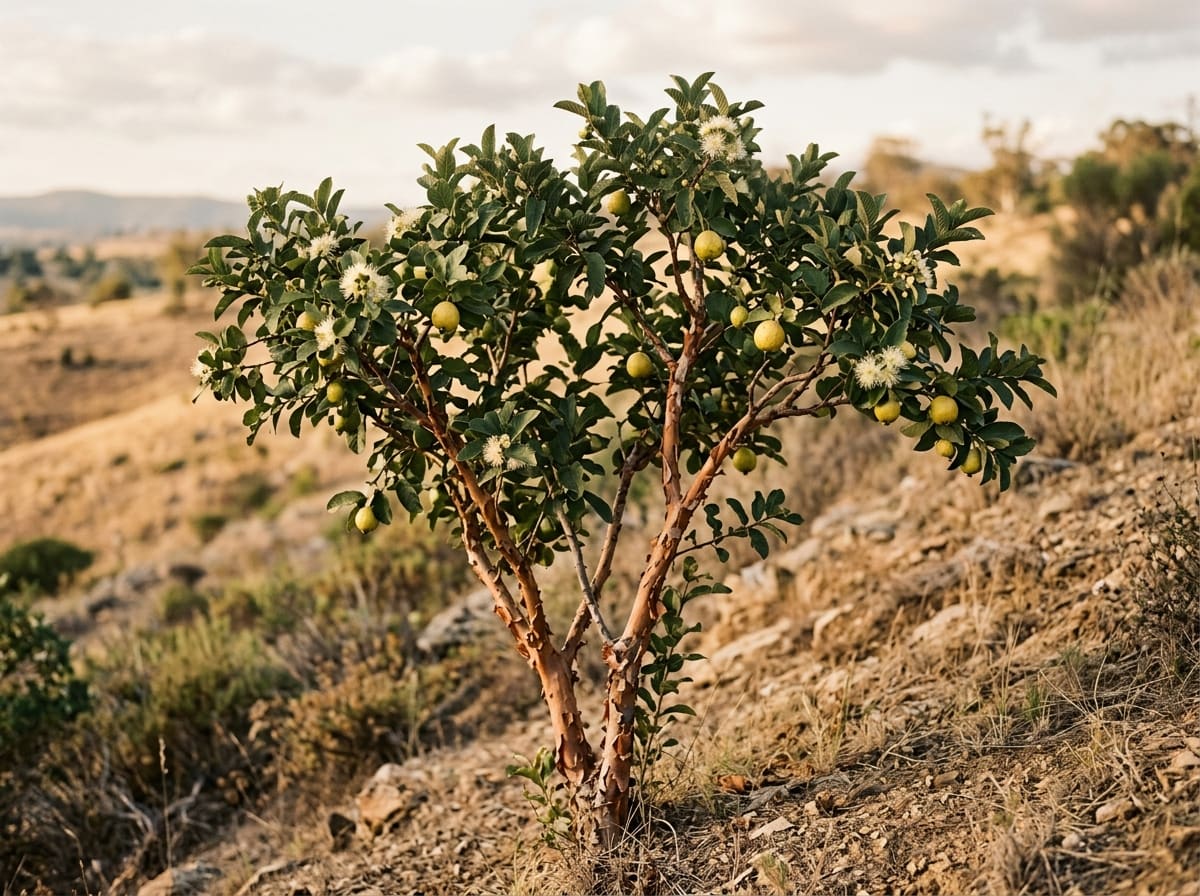
The guava is a small, tough fruit tree from tropical America. It grows as a single- or multi-stemmed tree up to about 6 metres, with smooth bark that peels in copper-coloured flakes and opposite, strongly veined leaves. It belongs to the myrtle family, the Myrtaceae, like the myrtle of the Mediterranean macchia and the eucalyptus. Its flowers are white with a dense brush of stamens, and its fruit fills a room with its scent when ripe.
Origin and growth
From tropical America the guava was carried throughout the tropics and subtropics early on. It grows quickly, branches low and fruits young: seedlings bear after two to four years according to Morton, after three to eight according to the University of Florida, and they do not come true to variety. Because the tree resprouts readily from the base and the roots, it survives damage that would kill many other fruit trees. The same quality makes it hard to remove once it has escaped.
Requirements
Cold. Young trees may be killed at -3 to -2 °C; mature trees survive short periods of -4 to -3 °C without much damage.
Water. The guava tolerates prolonged drought by pausing growth. For good fruit it needs water during flowering and fruit development. Short waterlogging is tolerated moderately.
Soil. Undemanding, from sand to clay, as long as water does not stand for long.
Light. Sun; in shade it grows lanky and bears little.
Fruit, use and harvest
Guavas are eaten fresh, as juice, jelly or a firm, sliceable paste. The fruit is rich in vitamin C: the USDA database gives about 228 milligrams per 100 grams of raw fruit. Ripe fruit softens and changes colour slightly; it bruises easily and keeps only a few days. Leaves and prunings are useful as mulch.
In many tropical countries guava leaves are a traditional household remedy, above all as a tea for diarrhoea; a review in the Journal of Ethnopharmacology (2008) collects these uses and the laboratory findings behind them. In Japan a guava leaf tea is approved as a food for specified health uses that dampens the rise in blood sugar after a meal. The evidence for this comes from enzyme and animal studies and from a few small human trials, summarised in 2010 by researchers of the company that sells the tea.
In the food forest
In a food forest the guava belongs to the small tree layer: below the tall canopy trees, in sun at the edges or in gaps. Because it tolerates drought and poor soils and resprouts after cutting, it can be pruned hard and repeatedly; the cuttings cover the soil as mulch. In succession it plays the part of a robust early fruit tree that bears while the long-lived trees are still young. Its invasive tendency is the other side of this toughness and needs watching: in a plant guild it should stay where it was planted.
In the Mediterranean climate
Around the Mediterranean, guava is grown commercially in Egypt, among other places, and there the Mediterranean fruit fly is one of its most important pests. A study in the Nile Delta found that fruit infestation peaked at about one fifth of the fruit in August and September. In southern Italy, researchers at the University of Palermo report that a wide range of tropical and subtropical fruit trees can be grown in Sicily if microclimate, varieties, irrigation and wind protection are chosen well. On a plantation near Orosei, about two hours north of Sa Medada, guavas have been bearing fruit for years.
The guava is not on the EU list of invasive alien species, but it is invasive on many tropical islands and in southern Africa, where birds and mammals spread its seeds. Whether it can spread in the Mediterranean is not well documented. Terra Humana deliberately uses some species that are invasive elsewhere, as a method; that is a stance, not an excuse. It means watching where seedlings appear and removing them where they are not wanted.
Propagation and care
Good varieties are propagated by air layering, cuttings or grafting; seed is used for rootstocks. Young trees need protection from frost in their first winters. Pruning after harvest keeps the tree compact and stimulates new fruiting shoots, since the guava flowers on young wood.
How Terra Humana understands it
At Sa Medada the guava stands for a tough, early-bearing fruit tree that can cope with dry summers and hard pruning. It is meant to bring fruit to the planting while the slower trees grow, and to give biomass from its cuttings. Because it spreads easily elsewhere, it is also a plant we observe with particular care.
Sa Medada
What this looks like at Sa Medada
At Sa Medada the guava grows in the open ground, planted out in the soil of the slope, and it is thriving.
More about Project EdenOrosei
Already bearing fruit in Orosei
About two hours north of Sa Medada, on a plantation of tropical and subtropical fruit near Orosei that has been growing for around 25 years, this plant has been bearing fruit for years. For us it is living proof that it thrives on the east coast of Sardinia, and the starting point of a joint project we want to build there.
Plants in this entry
- GuavaPsidium guajava
MyrtleMyrtus communis

Frequently asked
What is a guava?
The guava (Psidium guajava) is a small evergreen tree or large shrub of the myrtle family, the Myrtaceae, to which the myrtle of the Sardinian macchia also belongs. It comes from tropical America and has been spread throughout the tropics and subtropics. Its round to pear-shaped fruit has white, pink or red flesh, many small hard seeds and a strong, sweet scent. The bark is smooth and peels in thin flakes.
How cold can a guava get?
According to the University of Florida, young guava trees may be killed at -3 to -2 °C. Mature trees can survive short periods of -4 to -3 °C without much damage. Lower temperatures can kill stems, branches and trunk. Trees grown from cuttings or air layers often resprout from the base after such damage and bear again two to three years later.
Is the guava drought tolerant?
Yes, by the standards of tropical fruit trees. The University of Florida describes guava as tolerant of prolonged drought: the tree simply stops growing during dry spells. Drought during flowering and fruit growth, however, reduces fruit set and fruit size. Short periods of waterlogging, one to two weeks, are tolerated moderately well; longer flooding causes leaf drop and dieback.
Is the guava invasive?
In many tropical regions, yes. It is recorded as invasive in Hawaii, the Galápagos Islands, South Africa, East Africa and Queensland, among others. Birds, bats, cattle and pigs eat the fruit and spread the seeds, and the plant resprouts from its roots. In south Florida the University of Florida does not recommend planting it. It is not on the EU list of invasive alien species. In practice this means collecting fallen fruit and removing seedlings that come up away from the planting.
What pests affect guava in the Mediterranean?
The most important is the Mediterranean fruit fly, Ceratitis capitata, which lays its eggs in ripening fruit. In a study in two governorates of the Nile Delta in Egypt, the share of infested guava fruit peaked at about 20 percent in August and September. Prompt harvesting, collecting fallen fruit and, in gardens, bagging individual fruit reduce the damage.

Related terms


Mentioned in
Sources
- Crane & Balerdi, Guava Growing in the Florida Home Landscape, UF/IFAS Extension HS4/MG045
- Morton, Fruits of Warm Climates (1987): Guava, Purdue NewCROP
- Orwa et al., Agroforestree Database 4.0 (World Agroforestry, 2009): Psidium guajava
- Heleno et al., Seed dispersal networks in the Galápagos and the consequences of alien plant invasions, Proceedings of the Royal Society B 280 (2013)
- Morsi, El-Ashram & Abdou, Mediterranean fruit fly Ceratitis capitata in guava orchards in Dakahlia and Kafr El-Sheikh, Journal of Plant Protection and Pathology 14 (2023) 49 to 52
- Gambero Rosso, tropical fruit in Sicily, with Vittorio Farina, University of Palermo
- USDA National Nutrient Database (SR28), Guavas, common, raw (NDB 09139)
- Gutiérrez, Mitchell & Solis, Psidium guajava: a review of its traditional uses, phytochemistry and pharmacology, Journal of Ethnopharmacology 117 (2008)
- Deguchi & Miyazaki, Anti-hyperglycemic and anti-hyperlipidemic effects of guava leaf extract, Nutrition & Metabolism 7 (2010) 9
Last updated: 2026-10-13