
In brief
An evergreen fruit tree from South Asia, related to cashew and mastic; it needs a dry spell to flower and is damaged by even light frost.
- Botanical name
- Mangifera indica
- Family
- Anacardiaceae (cashew family)
- Origin
- South Asia, India to Myanmar
- Growth
- evergreen tree, 10 to 30 m wild
- Cold
- young trees die at -1 to -2 °C
- Water
- dry spell before flowering helps
- Food forest layer
- canopy tree
- Harvest
- 4 to 5 months after flowering
- At Sa Medada
- open ground
What is a mango?
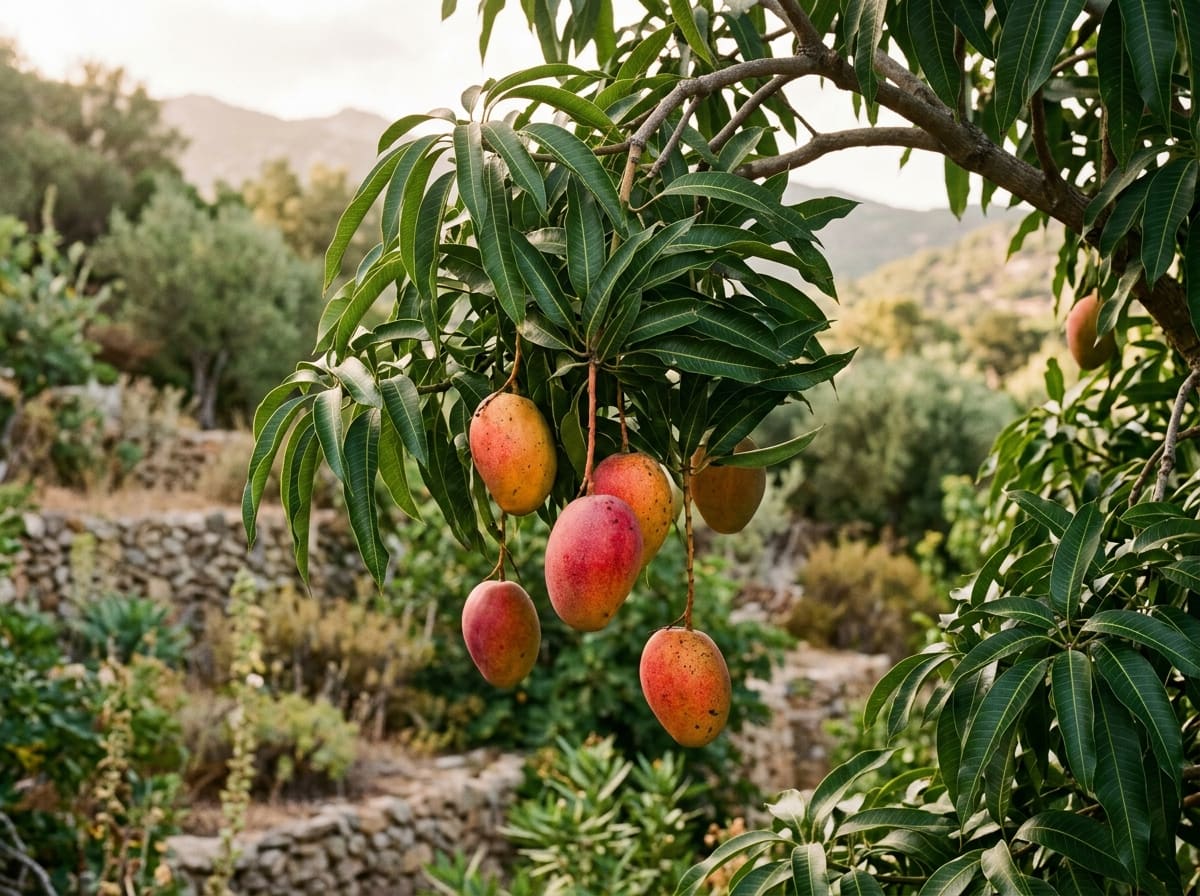
The mango is one of the great fruit trees of the tropics: evergreen, broad-crowned, with leathery, lance-shaped leaves that emerge reddish or bronze and slowly turn dark green. Its home is South Asia, where it has been cultivated since ancient times. Botanically it belongs to the cashew family, the Anacardiaceae. Around the Mediterranean that family is familiar from the pistachio and from the mastic tree of the macchia.
Origin and growth
Wild and old cultivated mango trees reach 10 to 30 metres and can live for centuries. In orchards they are kept far smaller by pruning. Flowers appear in large, branched panicles at the ends of the shoots; only a small share of them sets fruit. The fruit ripens about four to five months after flowering. A mango is ripe when the stalk snaps off with a slight pull.
Requirements
Climate. The mango is a tree of the tropical lowlands, adapted to latitudes between about 25 degrees north and south. It flowers best after a dry, cooler period; rain or fog during flowering is harmful.
Cold. Young trees may be killed at -1.1 to -1.7 °C; mature trees survive about -3.9 °C for a few hours with damage to leaves and twigs. The tree does not harden off.
Water. During fruit growth in summer it needs regular water. Too much water and rich soil promote leaves at the expense of flowers.
Soil. Not demanding, provided drainage is good. Sand, gravel and limestone are all possible.
Light. Full sun.
Fruit, use and harvest
Ripe mangoes are eaten fresh, as juice, preserves or dried fruit. Green mangoes go into chutneys and pickles. The sap of the stalk and branches and the peel of unripe fruit contain irritants that can cause blistering of the skin, often with a delayed reaction. Gloves during harvest and two separate knives for peeling and slicing are a sensible routine.
In the food forest
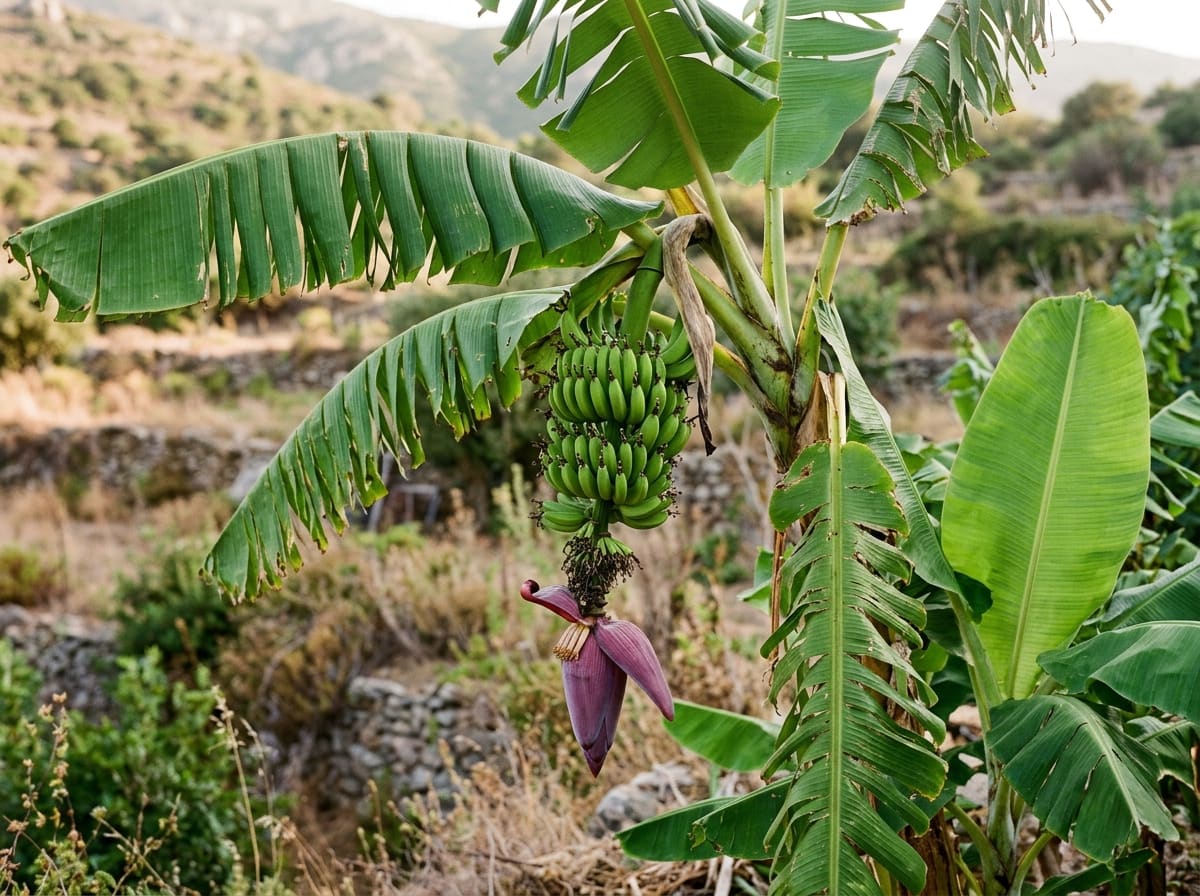
In a food forest the mango is a canopy tree: long-lived, large and, once established, dominant. In the early years it benefits from the protection of faster plants. Bananas, pioneer shrubs and nurse trees shade it against summer sun and break the wind; they are cut back as the mango grows and their prunings go onto the ground as mulch. In the logic of syntropic agriculture it belongs to the later, long-lived stages of succession, planted at the same time as the pioneers but meant to outlast them.
Because rain during flowering is harmful, a mango in a mixed planting needs an airy position where flowers dry quickly after dew.
In the Mediterranean climate
In Spain mango growing is concentrated in the Axarquía near Málaga, where more than 4,500 hectares were planted according to recent figures from the regional government. The region also shows the limits. During the drought of 2022 and 2023 the La Viñuela reservoir fell to a historic low, irrigation was cut back sharply, and a study by the University of Bern with partners in Málaga and Princeton reports mango crop failures of up to 80 percent compared with the previous year. In Sicily some farmers began planting mangoes on small farms in the early 1980s; an economic study from the University of Palermo found them clearly more profitable there than oranges or wine grapes. On a plantation near Orosei, about two hours north of Sa Medada, mangoes have been bearing fruit for years.
What makes it work in the Mediterranean is microclimate: frost-free sites, wind shelter, good drainage and enough water in summer. The mango is not on the EU list of invasive alien species.
Propagation and care
Good varieties are grafted onto seedling rootstocks; polyembryonic seeds can also be sown directly. Young trees are protected against frost and strong sun in their first winters and summers. Pruning after harvest keeps the tree low and the crown open. Too much nitrogen promotes leaves rather than flowers.
How Terra Humana understands it
At Sa Medada the mango stands for the question of how far tropical trees can be brought to a Sardinian slope with shelter, soil cover and careful water. It is meant to grow into a long-lived canopy tree that one day shades the layers beneath it. Whether it fruits reliably here is something only the coming years will tell.
Sa Medada
What this looks like at Sa Medada
At Sa Medada the mango grows in the open ground, planted out in the soil of the slope, and it is thriving.
More about Project EdenOrosei
Already bearing fruit in Orosei
About two hours north of Sa Medada, on a plantation of tropical and subtropical fruit near Orosei that has been growing for around 25 years, this plant has been bearing fruit for years. For us it is living proof that it thrives on the east coast of Sardinia, and the starting point of a joint project we want to build there.
Plants in this entry
- MangoMangifera indica
Mastic treePistacia lentiscus - BananaMusa


Frequently asked
Where does the mango come from?
The mango is native to South Asia, especially eastern India, Myanmar and the Andaman Islands, and has been cultivated there since ancient times. It belongs to the cashew family, the Anacardiaceae, which around the Mediterranean also includes the pistachio and the mastic tree. In its homeland the mango grows into a large, evergreen tree of 10 to 30 metres; some specimens are said to be 300 years old and still fruiting.
How cold can a mango tree get?
Not very. According to the University of Florida, young trees may be killed at -1.1 to -1.7 °C. Mature trees can withstand about -3.9 °C for a few hours, with damage to leaves and small branches. Mango trees do not harden off against cold, and no clear difference in cold tolerance between varieties has been found in Florida. Warm, frost-free sites near the coast or on slopes where cold air drains away are therefore decisive.
Why does a mango need a dry season?
Because dryness and cooler weather trigger flowering, while rain, heavy dew or fog during bloom harm the flowers and favour fungal disease. Morton puts it simply: the timing of rain matters more than the amount. The Mediterranean climate, with a dry spring and summer and rain mostly in winter, suits this rhythm in principle; the difficulty lies in the winter cold and in the water the tree needs while its fruit is growing in summer.
Is mango sap harmful?
The sap of the fruit stalk, trunk and branches and the peel of unripe fruit can irritate the skin and, in sensitive people, cause blisters and swelling of the face. The reaction often appears with a delay, similar to that of poison ivy, a relative in the same family. Harvesting with gloves, letting the stalk drip away from the skin and using one knife to peel and another to slice are sensible precautions.
Can a mango be grown from seed?
Yes, and the seed germinates readily, but the result depends on the type. Most Indian mangoes are monoembryonic, so a seedling differs from its parent. Many South-east Asian mangoes are polyembryonic: besides the sexual embryo the seed contains several vegetative ones that reproduce the mother tree faithfully. Seedlings take about six years to fruit, so good varieties are normally grafted.

Related terms


Mentioned in
- Apply self-regulation and accept feedback
- Cherimoya
- Creatively use and respond to change
- Design from patterns to details
- Energy: The Flow That Drives Everything
- Microclimate
- Observe and interact
- Obtain a yield
- Passion Fruit
- Pawpaw
- Stacking in space and time
- The design process
- The Nutrient Cycle
- Use and value diversity
- Use small and slow solutions
Sources
- Morton, Fruits of Warm Climates (1987): Mango, Purdue NewCROP
- Crane, Balerdi & Maguire, Mango Growing in the Florida Home Landscape, UF/IFAS Extension HS2/MG216
- Junquera et al., University of Bern with the University of Málaga and Princeton University: drought in the Axarquía, reported by uniAKTUELL (2025)
- Testa et al., economic analysis of mango orchards on small farms in Sicily, Sustainability 10 (2018)
- Junta de Andalucía, mango harvest estimates for Málaga, reported by FreshPlaza and El Debate (2025)
Last updated: 2026-10-13