
In brief
Tree species and varieties chosen for their ability to thrive in hotter, drier future conditions rather than the climate of the recent past.
Learning path: Trees that stay
Station 6 of 7
What are climate-adapted trees?
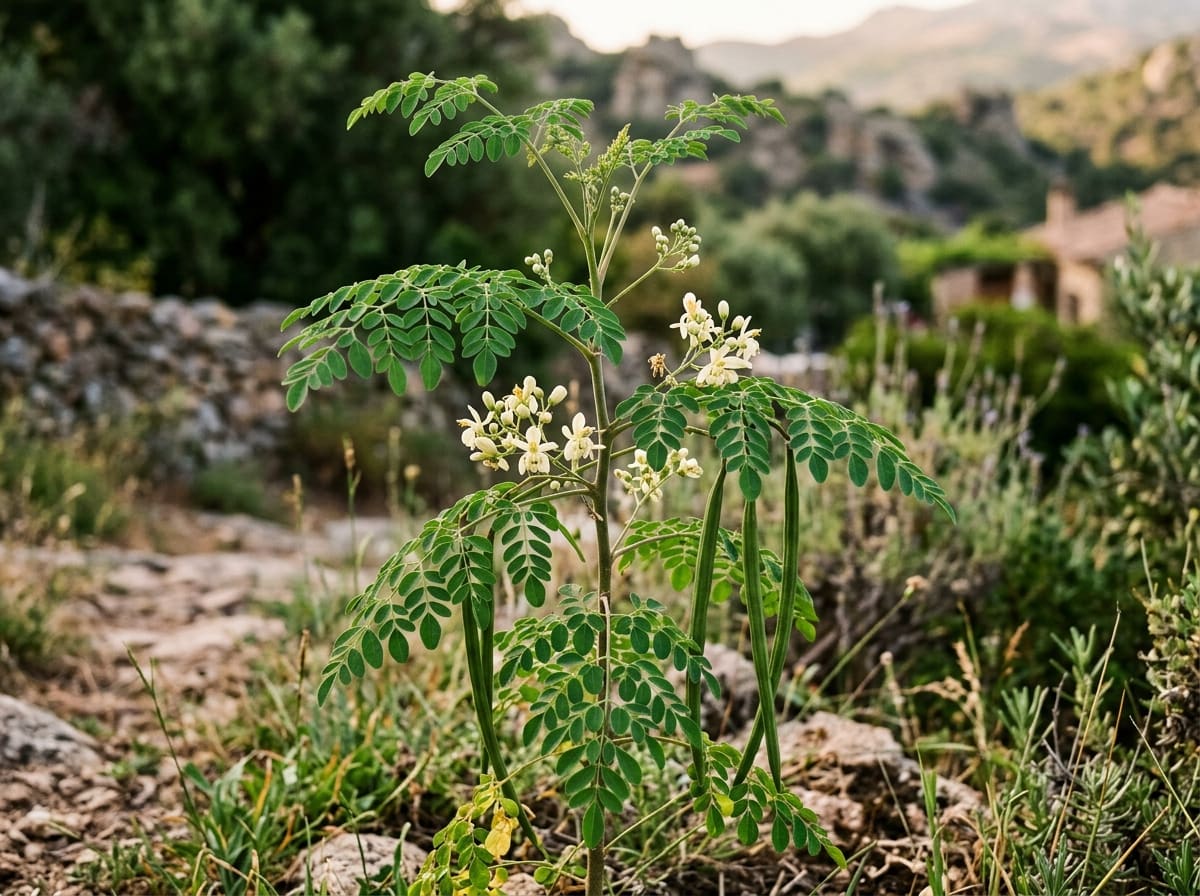
A tree planted today may live for a hundred years or more. The climate it must survive is not the climate of the past but the hotter, drier one of the future. Climate-adapted trees (in German often called Klimabäume or Zukunftsbäume, "future trees") are those chosen with that long horizon in mind: species and local varieties able to cope with rising heat, longer droughts and less predictable rain. The permaculture literature pushes the same argument further: choose species for their genetic value under future climate scenarios rather than against the norms of the past, and notice that some perform better as it gets hotter. Moringa and certain Sesbania species are singled out as stimulators, because in heat they actually grow faster.
The idea marks a shift in thinking. For generations, restoration meant replanting whatever historically grew on a site. But as conditions change faster than forests can migrate on their own, simply restoring the past can mean planting trees that will struggle in the climate to come. Choosing climate-adapted species means planting for the world the saplings will grow up in.
This does not mean abandoning native trees. Often it means favouring the toughest of them, seeking out drought-hardy varieties, and drawing carefully on species from hotter regions with similar conditions.
How Terra Humana understands it
Terra Humana plants trees meant to outlive the people who plant them. That makes resilience the first question: not only "what belongs here?" but "what will still be thriving here in fifty years?" Climate-adapted selection is how we try to answer honestly, in a Mediterranean region already among Europe's most exposed to heat and drought.
We hold this in balance. Native Mediterranean species (holm oak, wild olive, carob, the aromatic macchia shrubs) are deeply drought-adapted already, and Sardinia's ancient olives are living proof that the right tree can endure millennia of harsh summers. The task is less to import the exotic than to choose wisely among what is proven, and to widen resilience by planting variety.
Climate-adapted trees in practice
At Sa Medada, near Jerzu, Terra Humana plants a deliberate mix rather than betting on one species, and watches how each copes with the real heat and drought of the site. Deep-rooted natives, hardy fruit and nut trees, and the enduring olive are chosen for their ability to hold on through the dry summer.
This is a long experiment written in decades. By observing which trees flourish and which falter under a changing climate, Terra Humana gathers grounded, local knowledge about how to reforest dry Mediterranean land so that it stays a forest, and shares what it learns.
Sa Medada
What this looks like at Sa Medada
The first tree we planted at Sa Medada, in 2024, was a service tree, set deliberately on a very hot south-facing slope. It is thriving. Every planting since carries the same question further: which trees can take a summer drought that runs here from May to September, and the heat still to come?
More about Project EdenPlants in this entry
- MoringaMoringa oleifera
CarobCeratonia siliqua

Frequently asked
What are climate-adapted trees?
Climate-adapted trees, sometimes called future trees or climate trees, are species and varieties chosen because they can cope with the conditions expected in the decades ahead: more heat, longer droughts, and less reliable rainfall. Rather than replanting exactly what grew before, the idea is to plant what will still be healthy when today's saplings are mature trees.
How does Terra Humana choose climate-adapted trees?
Terra Humana favours species already proven in hot, dry Mediterranean conditions, including deep-rooted natives and time-tested trees like the olive, and observes closely how different species and provenances cope at Sa Medada. The aim is a resilient mix, not a single 'best' tree, so that the forest as a whole can withstand an uncertain climate.
Related terms


Mentioned in
See this in practice
Permaculture principles at work here
The design principles after David Holmgren that this page puts into practice.
Sources
- IPCC Sixth Assessment Report (AR6, WGII, 2022) impacts on forests and terrestrial ecosystems
- European Forest Institute, Adaptation of forests to climate change
- FAO, Framework for climate change adaptation of agriculture in the Mediterranean
- Bill Mollison, Permaculture: A Designers' Manual (1988)
Last updated: 2026-10-01