
In brief
An evergreen shrub of the myrtle family from eastern South America with ribbed, cherry-like fruit; invasive in Florida and on several islands.
- Botanical name
- Eugenia uniflora
- Family
- Myrtaceae (myrtle family)
- Origin
- eastern South America
- Growth
- evergreen shrub or tree, to 7.5 m
- Cold
- young plants hurt below -2.2 °C
- Water
- deep roots, copes with a dry season
- Food forest layer
- shrub layer, hedge
- Harvest
- about 3 weeks after flowering
- At Sa Medada
- pots and open ground, overwintered
What is a Surinam cherry?
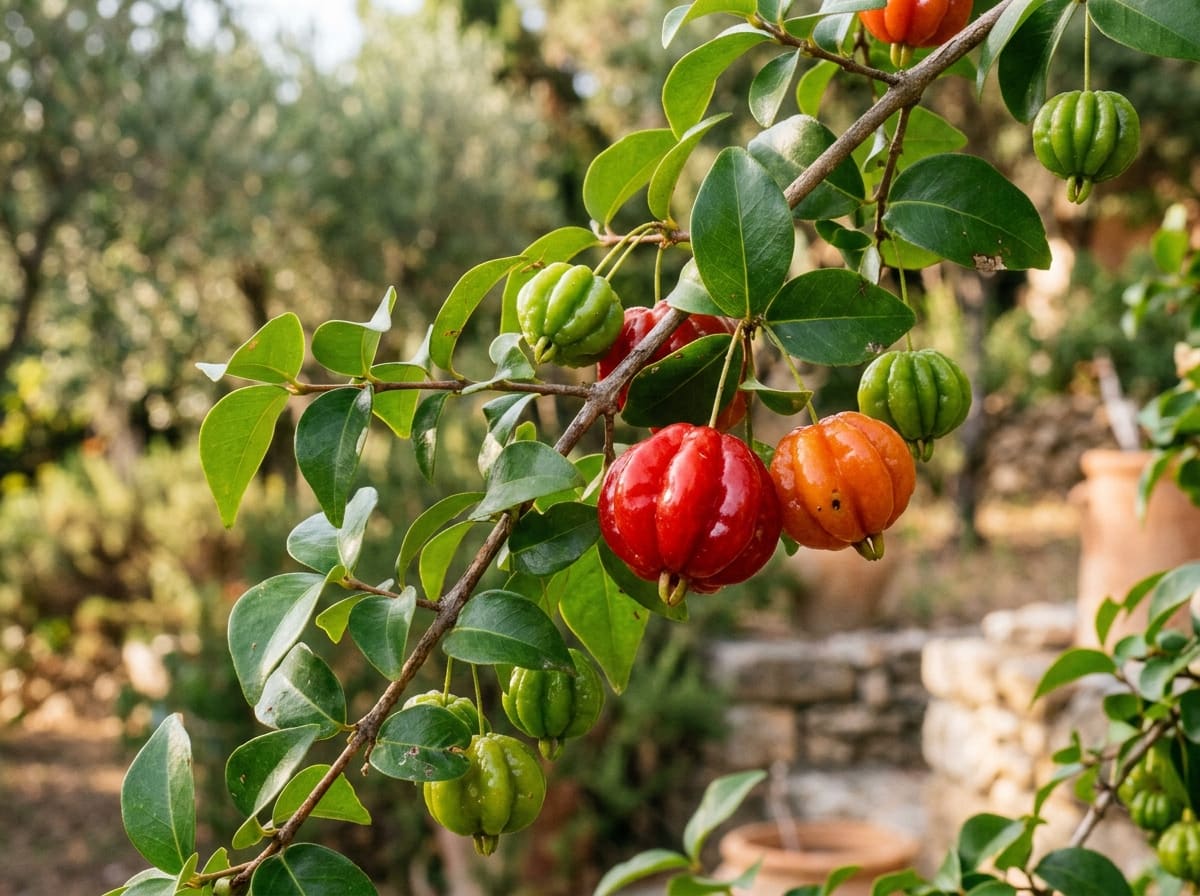
The Surinam cherry, called pitanga in Brazil, is an evergreen shrub of the myrtle family with glossy, aromatic leaves that emerge bronze-red and turn dark green. Its small white flowers sit singly or in small groups on long stalks, and the fruit that follows is unmistakable: a flattened sphere with seven or eight deep ribs, like a miniature pumpkin, turning from green through orange to scarlet or dark maroon. It is no relative of the true cherry; its relatives include the myrtle, the guava and the feijoa.
Origin and growth
Eugenia uniflora is native to eastern South America, from Surinam, Guyana and French Guiana south to southern Brazil and into Uruguay, and grows wild in thickets along the Pilcomayo River in Paraguay. Julia Morton notes that it was first described botanically from a plant growing in a garden in Pisa, a sign of how early it reached Europe.
It grows slowly into a dense shrub or small tree of up to about 7.5 metres, usually smaller, and takes pruning well, which is why it is often grown as a hedge.
Requirements
Climate. A plant of tropical and subtropical regions that loves full sun.
Cold. According to Morton, young plants are damaged below about -2.2 °C; well-established plants have suffered only superficial injury at about -5.6 °C.
Water. It needs only moderate rainfall and, being deep-rooted, can endure a long dry season.
Soil. Almost any soil will do: sand, loam, heavy clay and soft limestone. It tolerates waterlogging for a while but is intolerant of salt.
Fruit, use and harvest
From flower to ripe fruit takes only about three weeks. In Florida and the Bahamas there are usually two crops a year, one in spring and one in autumn. It is eaten fresh, with the seed removed, or made into jam, jelly, sauce and desserts. Taste varies from tree to tree; dark-fruited types are generally sweeter and less resinous.
Caution. The seeds are very resinous and should not be eaten. The spicy scent released when large bushes are pruned can irritate the airways of sensitive people.
In the food forest
In a food forest the Surinam cherry belongs to the shrub layer, beneath and between the trees, or along the edge as a fruiting hedge. It tolerates cutting, so it can be shaped to fit the space and its prunings returned to the ground as mulch. Its deep roots and modest water needs make it a candidate for the drier parts of a polyculture. In syntropic agriculture it would belong to the lower, longer-lived strata that grow up under the protection of faster pioneers.
In the Mediterranean climate
Morton reports that the Surinam cherry was planted long ago along the Mediterranean coast of North Africa and on the European Riviera. Experience has been mixed: in coastal Israel, where it was introduced in 1922, yields over ten years were disappointingly small. Morton describes it above all as a hedge and ornamental plant, and in temperate zones as a pot plant.
The more important point lies elsewhere. In Florida it is listed in the highest invasive category, because birds spread its seeds into natural woodland, where it forms dense thickets that are very difficult to control. It has also spread on many islands, among them Hawaii, Bermuda, the Bahamas and Réunion, and in Australia it is treated as an invasive garden escape. It is not on the EU list of invasive alien species. In practice that means picking the fruit rather than leaving it to the birds, and watching for seedlings beyond the planting.
Propagation and care
It is usually grown from seed, which stays viable for only about a month and germinates in three to four weeks. Volunteer seedlings transplant easily. Grafted plants of selected sweet types exist but tend to sucker below the graft. Young plants need protection from frost in their first winters; established shrubs need little more than occasional pruning.
How Terra Humana understands it
At Sa Medada the Surinam cherry is one of the plants that test how far subtropical shrubs can settle on a Sardinian slope. It could become part of a fruiting hedge in the shrub layer, quick to bear and easy to keep in shape. Its record as an invasive plant elsewhere is part of the picture. Terra Humana works deliberately with such species and wants to watch closely how this one behaves in a dry Mediterranean summer, where its seedlings appear and how far birds carry it.
Sa Medada
What this looks like at Sa Medada
At Sa Medada the Surinam cherry is already on the land, some plants still in their pots and some planted out in the ground. It has spent a winter outdoors and is thriving.
More about Project EdenPlants in this entry
- Surinam cherryEugenia uniflora
MyrtleMyrtus communis - GuavaPsidium guajava
- FeijoaAcca sellowiana


Frequently asked
What is a Surinam cherry?
The Surinam cherry or pitanga (Eugenia uniflora) is an evergreen shrub or small tree of the myrtle family. Its fruits look like small, deeply ribbed pumpkins, 2 to 4 centimetres across, ripening from green through orange to bright red or dark maroon. Despite the name it is not related to the cherry. Its home is eastern South America, from Surinam and the Guianas to southern Brazil and Uruguay.
How cold-hardy is the Surinam cherry?
Julia Morton reports that young plants are damaged below about -2.2 °C, while well-established plants suffered only superficial injury at about -5.6 °C. It is a plant of tropical and subtropical climates, so young plants need protection in their first winters, and frost hollows are best avoided.
What does a pitanga taste like?
It ranges from acid to sweet, with a resinous note and a slight bitterness. Dark red to purple types are usually sweeter and less resinous than the bright red ones. The fruit is eaten fresh, in desserts, or made into jam, jelly and sauces. Fully ripe fruit tastes best.
Is the Surinam cherry invasive?
It is not on the EU list of invasive alien species, but it is invasive elsewhere. In Florida it is listed in the highest category of invasive plants, because it escapes into natural woodland and forms dense thickets that are very hard to remove. It has also spread on many islands, among them Hawaii, Bermuda, the Bahamas and Réunion, and in Australia it is treated as an invasive garden escape. Birds eat the fruit and spread the seeds, which is the main way it travels.
Are the seeds or leaves harmful?
The seeds are extremely resinous and should not be eaten. Morton also reports that the strong, spicy scent released when large bushes are pruned can irritate the airways of sensitive people. The crushed leaves release an aromatic oil that repels flies; in Brazil the leaves were traditionally spread on floors for that reason.

Related terms


Mentioned in
Sources
- Morton, Fruits of Warm Climates (1987): Surinam Cherry, pp. 386 to 388
- University of Florida IFAS, Assessment of Non-native Plants in Florida's Natural Areas: Eugenia uniflora
- Florida Invasive Species Council (formerly FLEPPC), list of invasive plant species, Category I
- IUCN SSC Invasive Species Specialist Group, Global Invasive Species Database: Eugenia uniflora
- Centre for Invasive Species Solutions, WeedScan: Eugenia uniflora
- EPPO Global Database, list of invasive alien plants of Union concern (as of Implementing Regulation (EU) 2025/1422)
Last updated: 2026-10-13