
In brief
An evergreen shrub of the myrtle family from southern Brazil and Uruguay; fairly frost-hardy, with edible petals and aromatic green fruit in autumn.
- Botanical name
- Acca (Feijoa) sellowiana
- Family
- Myrtaceae (myrtle family)
- Origin
- southern Brazil, Uruguay, Argentina
- Growth
- evergreen shrub, 1 to 6 m
- Cold
- about -9 to -11 °C
- Water
- drought-resistant, fruit needs water
- Food forest layer
- shrub layer, hedge, windbreak
- Harvest
- autumn, 4.5 to 7 months after bloom
- At Sa Medada
- pots and open ground, overwintered
What is a feijoa?
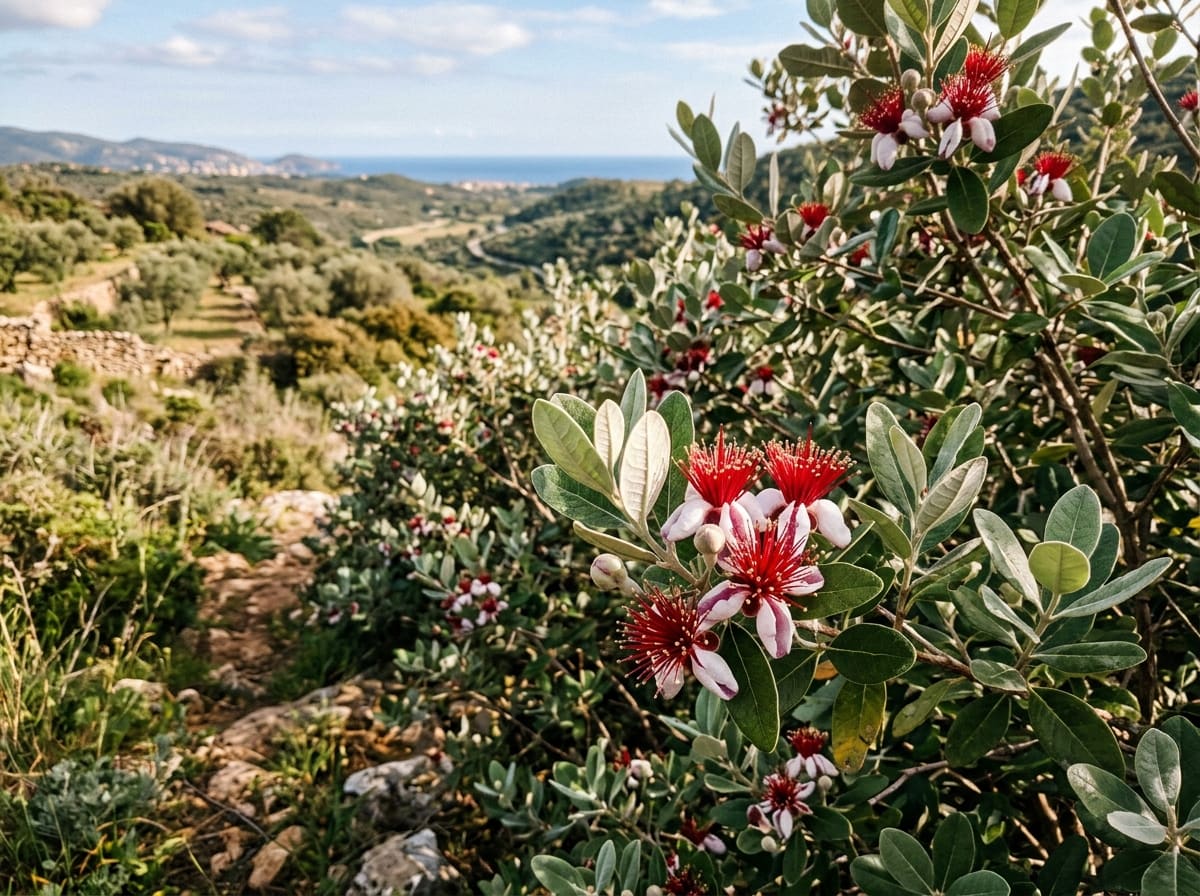
The feijoa is a dense, evergreen shrub of the myrtle family that is easy to spot even from a distance: its leaves are dark green above and silvery-felted beneath, so the bush seems to shimmer when the wind turns them. In late spring it bears striking flowers: fleshy petals, white outside and purplish red inside, around a tuft of upright purple-red stamens with golden anthers. The oval fruit stays dull green or yellow-green when ripe and gives off a strong, lasting perfume; Morton compares its flavour with a mix of pineapple and guava or pineapple and strawberry.
Origin and growth
The feijoa comes from the far south of Brazil, northern Argentina, western Paraguay and Uruguay, where Morton describes it as common in the wild in the mountains. The botanical name has changed several times, so both Acca sellowiana and Feijoa sellowiana are in use. The genus name honours the naturalist João da Silva Feijó, the species name the German plant collector Friedrich Sellow, who gathered it in southern Brazil.
As a shrub or small tree it reaches about one to six metres. It branches densely from the base and tolerates cutting well.
Requirements
Climate. Morton describes a subtropical climate with low humidity as ideal, and an annual rainfall of about 760 to 1,000 millimetres. The fruit tastes better in cooler regions.
Cold. It withstands about -9.4 to -11.1 °C, according to Morton, which is remarkable for a fruiting plant of subtropical origin.
Water. The feijoa is drought-resistant, but for a good crop it needs enough water while the fruit grows.
Soil and light. Undemanding about soil, as long as it drains. Full sun is best; it tolerates partial shade and light salt spray.
Fruit, use and harvest
The fruit ripens in autumn: in southern California four and a half to six months after flowering, around San Francisco five and a half to seven. Ripe feijoas fall on their own and are collected from the ground every day; mulch or straw beneath the shrub prevents bruising. The flesh and pulp, small seeds included, are eaten raw or made into jam, juice and desserts.
The fleshy petals are edible too, sweet and slightly spicy, and picking them does not reduce fruit set. Bees are the main pollinators; birds that eat the petals carry pollen as well. Many varieties are partly or highly self-incompatible, so two different varieties planted close together bear more reliably.
In the food forest
In a food forest the feijoa belongs to the shrub layer, at the sunny edge of a planting or between young trees. Its dense, evergreen growth makes it a good hedge and windbreak; in New Zealand it is planted around wind-sensitive crops for exactly that reason. Prunings and the leaves it sheds can stay on the ground as mulch. Its frost hardiness and drought resistance make it one of the more reliable subtropical shrubs for a dry polyculture. In syntropic agriculture it would be one of the long-lived shrubs that hold the lower strata once the pioneers are gone.
In the Mediterranean climate
The feijoa reached the Mediterranean early. In 1890 the French horticulturist Édouard André brought a plant from Brazil to his garden on the Riviera, where it first fruited in 1897. From 1899 a nurseryman in Lyon distributed propagated plants, and plantings followed on the Riviera, in Italy and in Spain. In California seedlings arrived in 1901. In New Zealand, where it later became a popular fruit, it was introduced from Australia around 1908.
Its frost hardiness and its liking for low humidity suit the Mediterranean climate. Where summers are dry, water during fruit growth decides the size of the crop.
The feijoa is not on the EU list of invasive alien species.
Propagation and care
Seedlings take three to five years to bear and vary in fruit quality, so selected varieties are propagated vegetatively. Ground layers root in about six months, and air layers can bear in their second year; cuttings root under warm, humid conditions. Pruning keeps the shrub open or shapes it as a hedge. In the first summers young plants need water and a mulched root zone.
How Terra Humana understands it
At Sa Medada the feijoa could do several jobs in one place: bear fruit late in the year and break the wind as an evergreen hedge for more sensitive neighbours. Among the subtropical plants growing at Sa Medada it is one of the most frost-tolerant, which makes it a steady element in a planting that is still finding its way. How much water it needs in a dry Sardinian summer to set a good crop is one of the things the coming years will show.
Sa Medada
What this looks like at Sa Medada
At Sa Medada the feijoa is already on the land, some plants still in their pots and some planted out in the ground. It has spent a winter outdoors and is thriving.
More about Project EdenPlants in this entry
- FeijoaAcca sellowiana
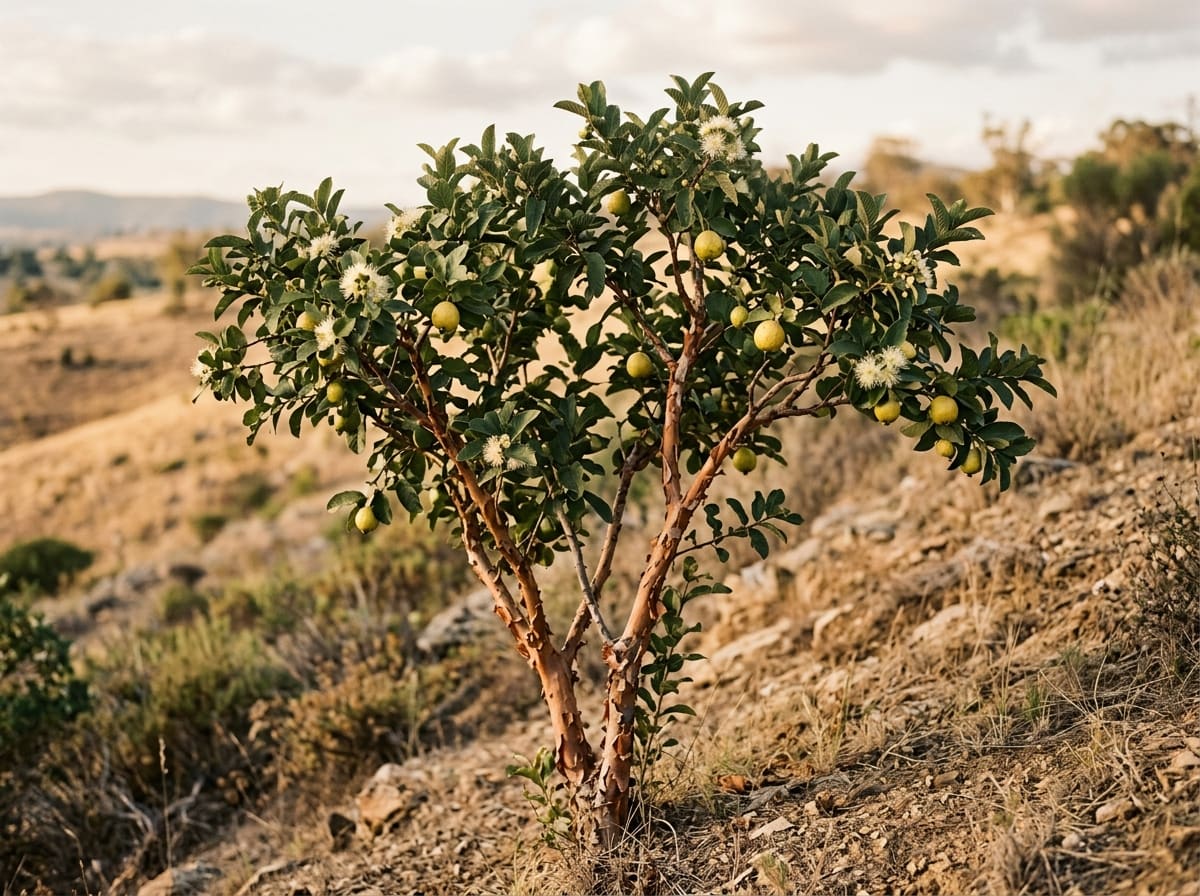
MyrtleMyrtus communis - GuavaPsidium guajava


Frequently asked
What is a feijoa?
The feijoa, also called pineapple guava, is an evergreen shrub or small tree of the myrtle family. Its leaves are glossy dark green above and silvery-felted beneath, its flowers have thick, fleshy petals around a tuft of upright purple-red stamens, and its egg-shaped green fruit has a strong, lasting perfume. Botanically it is known as Acca sellowiana or Feijoa sellowiana; the genus name honours the naturalist João da Silva Feijó, the species name the plant collector Friedrich Sellow.
How cold-hardy is the feijoa?
Julia Morton states that it withstands temperatures as low as about -9.4 to -11.1 °C. That is unusually hardy for a plant of subtropical origin. Morton also notes that its fruit tastes better in cooler regions, and that it prefers a subtropical climate with low humidity.
Can you eat feijoa flowers?
Yes. The thick, fleshy petals are sweet and spicy and are eaten fresh, often by children. According to Morton, picking the petals does not reduce fruit set. Birds also eat them and carry pollen in the process, but bees are the main pollinators.
Does a feijoa need a second plant to bear fruit?
Often, yes. Varieties differ widely: Morton describes 'Coolidge' as fully self-fertile and 'Choiceana' as partly so, while 'Superba' and 'Bliss' are partly and 'Hirschvogel' highly self-incompatible. With compatible pollination, 60 to 90 percent of flowers set fruit. Planting two different varieties near each other is the safe choice.
When are feijoas ripe?
In autumn. In southern California the fruit ripens four and a half to six months after flowering, around San Francisco five and a half to seven. Ripe feijoas fall from the bush on their own and are gathered from the ground; a layer of straw or mulch beneath the bush prevents bruising. The flesh and pulp, with the small seeds, are eaten raw, as dessert or in salads.

Related terms


Mentioned in
Sources
- Morton, Fruits of Warm Climates (1987): Feijoa
- Oregon State University, Landscape Plants: Acca sellowiana (naming and authorship)
- EPPO Global Database, list of invasive alien plants of Union concern (as of Implementing Regulation (EU) 2025/1422)
Last updated: 2026-10-13