
In brief
In a Mediterranean climate the garden year begins with the first autumn rain and has two seasons: a wet one for planting and a dry one for protecting.
What is the Mediterranean garden year?
Anyone looking for a Mediterranean planting calendar or a permaculture calendar for a dry-summer climate soon finds that the familiar order of the year does not fit. In central and northern Europe the garden wakes in spring and rests in winter. Around the Mediterranean the decisive moment comes at the other end of the year: the garden year begins with the first autumn rain. What counts are not four seasons but two, a wet one from roughly October to April and a dry one from roughly May to September. Almost everything the land is meant to carry through the summer has to be set up in the wet half.
This article follows that rhythm through the year in broad strokes. It is a frame for lower, largely frost-free locations, not a timetable. When the first rain comes, how long the wet season lasts and when the soil dries out changes from year to year and from place to place.
Tap a month to see what the garden asks for.
Month 10 · Wet season
October
The spring of the south: the soil softens and planting begins.
What to do
- Plant trees and shrubs after the first good rain.Nurse TreesFood Forest
- Sow green manure and covers on moist soil.Green ManureCover Crop
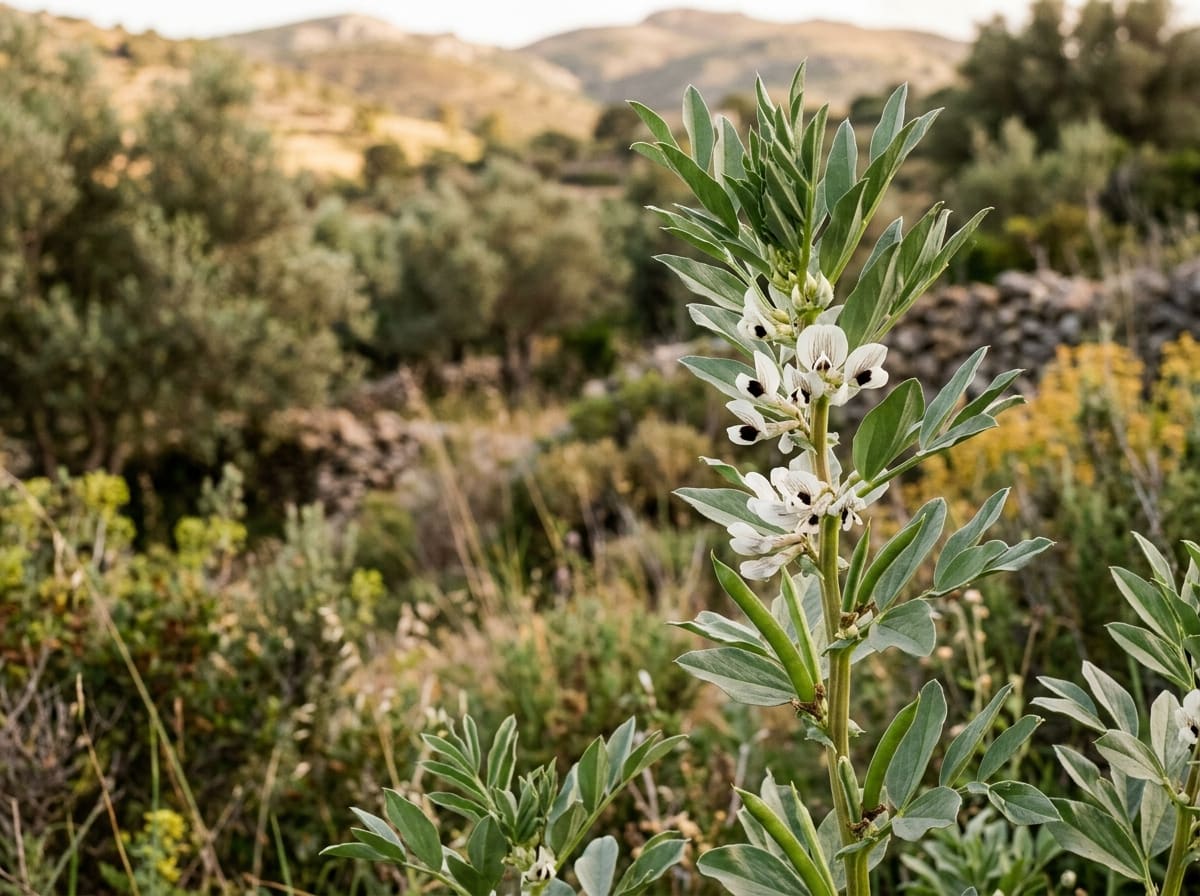
- Sow fava beans and plant cabbages, onions and garlic.Fava Bean
Two seasons instead of four
A Mediterranean climate has a precise meaning. In the Köppen-Geiger classification it is a temperate climate with a dry summer, abbreviated Cs: the driest summer month receives less than 40 millimetres of rain and less than a third of what falls in the wettest winter month. If the warmest month averages 22 degrees or more, the type is Csa, with hot summers; if it stays below that but at least four months average 10 degrees or more, it is Csb, with warm summers. Besides the Mediterranean Basin, this climate occurs in four other regions of the world: California, central Chile, the Cape region of South Africa and the south and southwest of Australia.
For the garden, the decisive feature is that warmth and water arrive at different times. When the soil is warm enough for strong growth, it is dry; when it is moist, the days are short and cool. The wild plants of this climate have adapted: many grow in autumn, winter and spring and pause in summer. A garden that wants to manage with little irrigation adopts the same rhythm. The wet season is for planting, sowing and building soil, the dry season for protecting what has grown.
Autumn: the spring of the south
The first good rain after the summer, usually in September or October, opens the year. The soil, dry and hard for months, softens, the seeds of annual plants germinate and the hills turn green again. For the gardener this is what spring is further north.
The main reason is the roots. A tree or shrub planted in autumn has the whole wet season to grow into moist soil before its first summer. Reforestation research in Spain links the survival of young plants in Mediterranean plantations above all to how well they grow during the wet season, while summer drought is the main cause of losses. Gardeners in California, which shares the climate, give the same advice: plants set out in autumn root with the winter rains and need only a few supplementary waterings in their first summer or two. Planted in late spring, the same plant meets the heat with a root ball that has hardly reached the surrounding soil.
Autumn is also the time to sow. Green manure and cover crops go in with the first rain, grow through the mild winter and protect the ground when heavy rain falls on soil that has just come out of the summer. The fava bean, one of the oldest crops of the region, is sown in October or November and ripens before the drought. Cool-season vegetables such as cabbages, lettuce, onions, garlic and peas belong to this half of the year as well.
Winter: planting, pruning, catching water
In lower, frost-free locations the Mediterranean winter is a growing season, not a pause. Planting continues as long as the soil is moist and workable, and deciduous fruit trees can go in bare-rooted while they are dormant. Every tree that is in the ground before the end of winter gains time for its roots.
Winter is also the season for pruning. Support plants are cut when rainfall exceeds evaporation, and the cuttings stay on the ground as mulch: this is chop and drop. The cut lets light down to young trees, and the material decomposes on moist soil instead of drying out. Green manures keep growing and build up mass.
The third task is water. Rain that runs off in winter is missing in summer. Rainwater harvesting in its many forms aims to keep it: a roof water cistern stores it for the dry months, a swale along the contour lets it soak into the slope, and covered soil takes in more of every shower than bare soil. Winter storms also show where water runs, collects or carries soil away. Walking the land in heavy rain teaches more about it than any map.
Spring: mulch before the soil dries
Spring is the hinge of the year. Growth is at its height, but the soil begins to lose water faster than rain can refill it. The most important task now is to cover the ground while it is still moist. Mulch laid on dry soil keeps the dryness in; laid in March or April on soil still wet from winter, it keeps the moisture for weeks longer.
Green manures and covers are cut now, as a rule at the beginning of flowering and in any case before the soil dries out, because a stand that keeps growing draws on the same water the trees need. The cut material stays on the surface as mulch. Support plants and vigorous species are cut before their seed ripens, so that the mulch does not sow the next generation. When that moment comes is decided by the year: after a dry winter it comes earlier.
Spring is also the time for summer crops. Tomatoes, peppers, aubergines, beans, squash and melons are warm-season plants that do not tolerate frost. According to the Royal Horticultural Society, tomato seed needs about 18 degrees to germinate, and young plants go outside once temperatures stay reliably above 16 degrees. Around the Mediterranean that point comes earlier than in northern Europe, but these crops then grow into the dry season and depend on water. Mulch, some shade at midday and deep, infrequent watering make the difference.
Summer: protect, water deeply, observe
From about May to September the garden lives on what was prepared in the wet season. The guiding idea is protection, not production.
Shade stays. Support plants are not cut in summer, because standing shade protects soil and young trees better than any layer of mulch. Watering is sparing and deep: the Royal Horticultural Society advises watering less often but more thoroughly and letting the surface dry in between, for young trees and shrubs to a depth of 20 to 30 centimetres, where the roots grow, and preferably early in the morning. Buried clay pots, ollas, release water right at the roots with little loss. The aim over the years is a planting that lives on the winter rain stored in the soil.
Fire belongs to the Mediterranean summer. A wet season that grows plant mass, followed by months of heat and drought, leaves vegetation dry and flammable, and fire has shaped these landscapes for a very long time. In the garden this calls for general care: no dry cuttings or mulch heaped near buildings or along paths, green and moist zones around the house, and attention to local warnings.
Summer is also the season for observing and for seed. Many plants of the wet season ripen their seed in early summer, and the dry air makes drying easy. Seed saving from the plants that coped best adapts the varieties to the place, harvest by harvest. Which plants wilt first, where the soil stays moist longest, where the ground cracks: summer shows the weak points that the autumn planting can address. This is the practical sense of the principle observe and interact.
Limits: climate is local
No calendar replaces the place. The months named here are a frame for lower, largely frost-free Mediterranean locations, and even within one region conditions differ widely. Higher up, winters are colder and frost is regular, so tender plants wait for spring and the season shifts. Coasts are milder than inland valleys, south-facing slopes dry out earlier than north-facing ones, and on calm nights cold air flows downhill and gathers in hollows and valley floors. The microclimate of a single slope can matter more than the average of the nearest weather station.
The years differ too. The first autumn rain may come in September or only in November, and a dry winter brings the spring cut forward. The rule behind the calendar therefore matters more than its dates: plant and sow when the soil is moist, cover it before it dries, protect in summer. Whoever follows that rule and watches the actual year can respond to change instead of to a date.
How Terra Humana understands the garden year
For Terra Humana the Mediterranean garden year is above all a matter of water. In a climate where rain falls in one half of the year and growth is needed in the other, the gardener's work is to carry water from winter into summer: in the soil, in roots, in mulch and in stores. We plant with the rain, prune when rainfall exceeds evaporation and keep the shade in summer. The calendar is our starting point; what the land shows in a given year corrects it.
Sa Medada
What this looks like at Sa Medada
Sa Medada lies on the eastern side of Sardinia, with mild winters and a dry season from about May to September, and its year follows the rhythm described here. Pruning happens when rainfall exceeds evaporation, which there means winter and spring, and the cuttings go back onto the ground as mulch; in summer every bit of shade stays. Fava beans are in the ground as one of the nitrogen fixers, and Tagasaste, raised from seed since August 2026, is to be planted out with the winter rain. Swales are planned; none has been built yet.
More about Project EdenPlants in this entry
- Fava beanVicia faba
TagasasteChamaecytisus proliferus

Frequently asked
When does the garden year begin in a Mediterranean climate?
With the first good rain after the summer, usually in September or October. Further north the garden wakes in spring; around the Mediterranean the soil softens, seeds germinate and the hills turn green in autumn. The year then falls into two seasons rather than four: a wet one from roughly October to April, when planting, sowing and soil building happen, and a dry one from roughly May to September, when the garden lives on what was prepared before.
When is the best time to plant trees in a Mediterranean climate?
From the first autumn rain through the winter, as long as the soil is moist and workable. A tree planted then has the whole wet season to root into moist soil before its first summer. Research on plantations in Spain links seedling survival above all to how well young plants grow during the wet season, while summer drought causes most losses. Even trees planted in autumn usually need some deep watering in their first summer or two.
What exactly is a Mediterranean climate?
In the Köppen-Geiger classification it is a temperate climate with a dry summer, abbreviated Cs. The driest summer month receives less than 40 millimetres of rain and less than a third of the wettest winter month. With a warmest month averaging 22 degrees or more the type is Csa, with hot summers; below that, with at least four months averaging 10 degrees or more, it is Csb. Besides the Mediterranean Basin it occurs in California, central Chile, the Cape region of South Africa and southern and southwestern Australia.
What is done in the garden in a Mediterranean summer?
Mainly protecting. Shade stays standing, because it protects soil and young trees better than any mulch layer. Watering is sparing and deep rather than frequent and shallow, best early in the morning. Dry cuttings and mulch are kept away from buildings and paths because of fire. Summer is also the time to harvest seed from the plants that coped best and to observe where the land is weakest, so that the autumn planting can respond.
Does one calendar fit the whole Mediterranean?
No. The months are a frame for lower, largely frost-free locations. Higher up, winters are colder and frost is regular, so tender plants wait for spring. Coasts are milder than inland valleys, south-facing slopes dry out earlier than north-facing ones, and cold air gathers at night in hollows. The years differ as well: the first rain may come in September or November. The rule behind the dates matters more than the dates: plant when the soil is moist, cover it before it dries, protect in summer.

Related terms


See this in practice
Sources
- Beck, H.E., Zimmermann, N.E., McVicar, T.R., Vergopolan, N., Berg, A. and Wood, E.F., Present and future Köppen-Geiger climate classification maps at 1-km resolution, Scientific Data 5, 180214 (2018)
- Rundel, P.W., Arroyo, M.T.K., Cowling, R.M., Keeley, J.E., Lamont, B.B. and Vargas, P., Mediterranean biomes: evolution of their vegetation, floras, and climate, Annual Review of Ecology, Evolution, and Systematics 47 (2016)
- Villar-Salvador, P. et al., Increase in size and nitrogen concentration enhances seedling survival in Mediterranean plantations. Insights from an ecophysiological conceptual model of plant survival, New Forests 43 (2012)
- McDaniel, P., Fall is Time for Planting Natives, California Native Plant Society, Channel Islands Chapter (first published in the Ventura County Star, November 2007)
- Andy Clark (ed.), Managing Cover Crops Profitably, 3rd edition, SARE (2007)
- Gómez et al., Soil erosion control, plant diversity, and arthropod communities under heterogeneous cover crops in an olive orchard, Environmental Science and Pollution Research 25 (2018)
- Annicchiarico and Iannucci, Winter survival of pea, faba bean and white lupin cultivars in contrasting Italian locations and sowing times, Journal of Agricultural Science 145 (2007)
- Royal Horticultural Society, Watering plants wisely, rhs.org.uk (accessed October 2026)
- Royal Horticultural Society, How to grow tomatoes, rhs.org.uk (accessed October 2026)
- Bainbridge, D.A., Buried clay pot irrigation: a little known but very efficient traditional method of irrigation, Agricultural Water Management 48 (2001)
- Brad Lancaster, Rainwater Harvesting for Drylands and Beyond, Vol. 1: Guiding Principles, 3rd edition (2019)
- Pausas and Keeley, A burning story: the role of fire in the history of life, BioScience 59 (2009)
- Suzanne Ashworth, Seed to Seed: Seed Saving and Growing Techniques for Vegetable Gardeners, 2nd edition, Seed Savers Exchange (2002)
- Rudolf Geiger, The Climate Near the Ground, revised by Robert H. Aron and Paul Todhunter, Rowman and Littlefield (7th edition 2009)
- Bill Mollison, Permaculture: A Designers' Manual, Tagari Publications (1988)
- David Holmgren, Permaculture: Principles and Pathways Beyond Sustainability, Holmgren Design Services (2002)
Last updated: 2026-10-19