

In brief
A small raised mound built in a spiral, which packs several climates into a few square metres so that herbs with opposite needs can grow side by side.
What is a herb spiral?
A herb spiral is a raised mound with a spiral of stone or dry-stone walling winding from its outer edge to its top. It stands roughly waist high, between one metre and one metre thirty, and measures about two metres across at its base. It is one of the best known designs to come out of the permaculture literature, and it is a good example of what that literature is actually for: not a style, but a way of getting several conditions out of one small structure.
The design works because height and orientation change everything a plant experiences. Water drains from the top and collects at the base, so the summit is dry and the foot is damp. Stone at the top holds the day's heat and releases it at night. One flank faces the sun for most of the day while the opposite flank sits in its own shade. In a few square metres you therefore have a hot dry ridge, a series of intermediate bands, and a cool moist hollow, which in a flat bed would need three separate beds in three separate places.
The spiral shape does two further jobs. It creates more planting edge than a straight bed covering the same ground, and edges are where a garden is most productive. And it puts everything within arm's reach from the path, so the soil is never walked on and never compacted.
There is a practical reason it is nearly always placed by a door. Herbs are picked in small quantities, often, usually while cooking. A herb bed twenty paces away is visited less than one built next to the kitchen, and a plant that is not visited is not harvested and not noticed when it needs something.
How Terra Humana understands the herb spiral
For Terra Humana the herb spiral is interesting less as a garden feature than as a teaching object. It demonstrates, at a size a person can take in at a glance, the principle the whole of our work depends on: that shaping ground changes climate. Raise a mound and you have made somewhere drier. Put stone on the sunny side and you have made somewhere warmer. Cast shade and you have made somewhere a plant can survive a Sardinian August. The same reasoning, applied at the scale of a slope, is what terracing and dry-stone walls have done in Ogliastra for centuries.
There is a twist here that the standard instructions do not cover. In northern Europe the difficult part of a herb spiral is the dry top, because the climate is against it and the Mediterranean herbs at the summit are the exotic ones. In Ogliastra it is the other way round. Rosemary, thyme, sage, myrtle and helichrysum are not imports here, they are macchia plants growing wild on the slopes around us. The dry, stony, sun-exposed conditions at the top of the spiral are simply the local default.
What is genuinely hard for us is the damp, shaded base, the part a temperate manual treats as effortless. Parsley, chervil and mint want a cool, consistently moist root zone, and holding that through a rainless summer is real work. So we read the design inverted: the top takes care of itself, and the design effort goes into the shaded foot.

Sa Medada
What this looks like at Sa Medada
What a herb spiral shows on a small scale, we have mapped on a large one for Sa Medada: LiDAR data produced a solar aspect map that shows the warmest and most sheltered zones of the south-facing slope. That is where the frost-sensitive species belong. The logic is the same as in the spiral: the shape and orientation of the ground make the climate a plant experiences.
More about Project EdenPlants in this entry
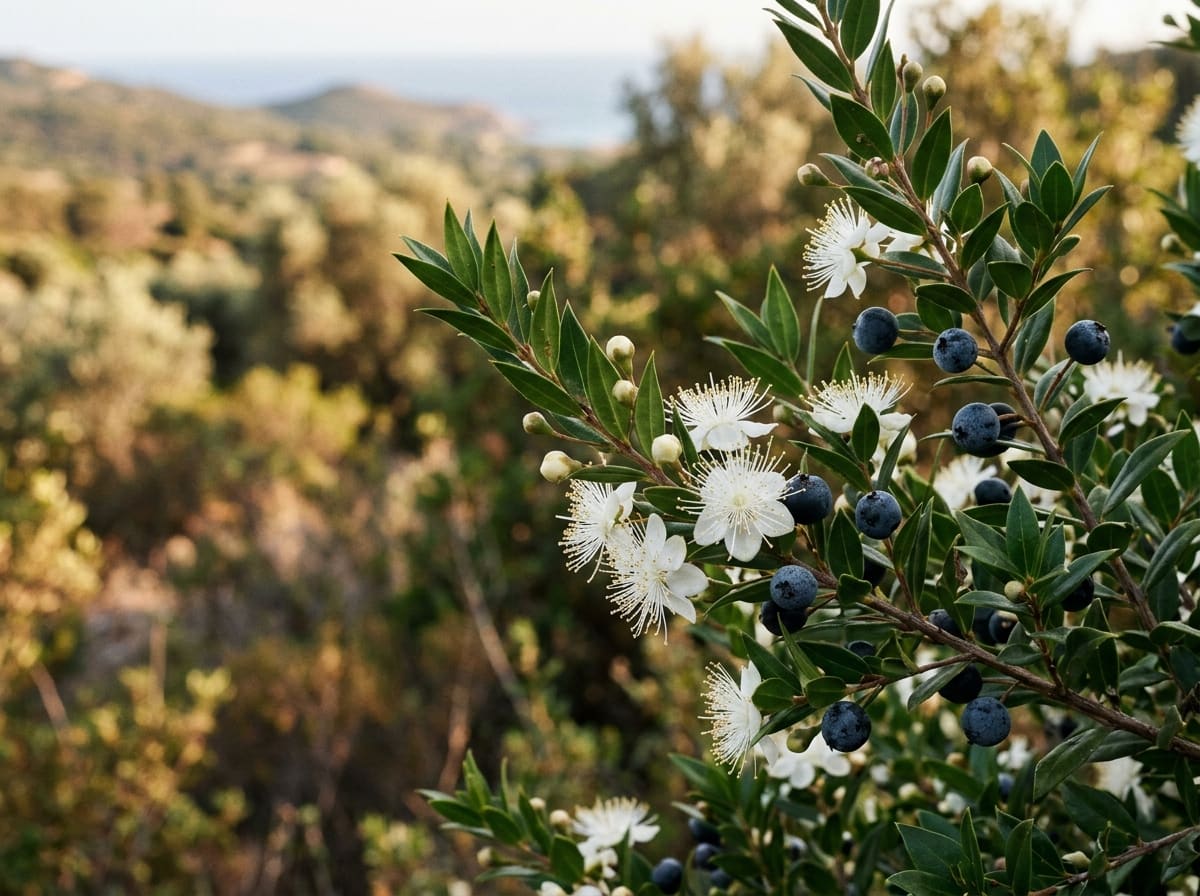
MyrtleMyrtus communis

Frequently asked
What is a herb spiral?
A herb spiral is a raised mound, usually about waist height and a couple of paces across, built up in a spiral so that a path of stone or dry-stone walling winds from the outside edge to the top. The point is not decoration. The climb creates a gradient: the top is higher, drier, better drained and more exposed, the base is lower, cooler and damper, and the sides face in every direction. Plants with completely different needs can therefore be grown within arm's reach of each other.
Which herbs go where?
Dry and sun-loving plants belong at the top and on the sunny flank: rosemary, thyme, sage, oregano, lavender. The eastern flank, which takes the morning sun and is spared the afternoon heat, is the place for coriander. The cool, moist northern side is for chives and parsley, and the shaded foot for chervil and for mint, which is best kept where its roots cannot escape into the rest of the garden. Classically the spiral ends at its base in a small pond, and that is where watercress and mint belong.
Why build a spiral instead of a flat bed?
Because a spiral buys surface and variety in the same footprint. Winding the path upward gives more planting edge than a straight bed of the same area, puts every plant within reach without stepping on the soil, and turns a single small structure into several distinct growing conditions. It is also compact enough to sit next to a kitchen door, which is where herbs are actually used.

Related terms


See this in practice
Sources
- Bill Mollison & David Holmgren, Permaculture One (1978)
- Bill Mollison, Permaculture: A Designers' Manual (1988)
- Bill Mollison, Introduction to Permaculture (1991)
- Toby Hemenway, Gaia's Garden, A Guide to Home-Scale Permaculture (2nd ed., 2009)
Last updated: 2026-10-01